The Silent Circulatory System: What Your Lymphatic Network Actually Does and Why Science Is Only Beginning to Appreciate It
Ask a room full of adults to name the body's major organ systems, and most will rattle off the cardiovascular, respiratory, and digestive systems with relative confidence. Fewer will mention the endocrine or nervous systems. Almost none will name the lymphatic system — and yet this intricate, body-wide network is operating continuously beneath awareness, performing tasks so essential that its failure is incompatible with survival.
The lymphatic system is not a secondary structure. It is, by any rigorous physiological definition, a primary one. Its neglect in popular health discourse is not a reflection of its importance but rather a consequence of its invisibility. Unlike the heart, it does not beat with a perceptible rhythm. Unlike the lungs, it does not expand visibly with each breath. It simply works — until, under certain conditions, it does not.
Anatomy of a Misunderstood System
The lymphatic network consists of a vast web of thin-walled capillaries, larger collecting vessels, lymph nodes, and several specialized organs including the spleen, thymus, and tonsils. This system runs in parallel with the cardiovascular network but operates under an entirely different mechanical logic.
Blood circulation is a closed loop driven by the heart's muscular contractions. Lymphatic circulation, by contrast, is an open system with no central pump. Lymphatic capillaries begin as blind-ended tubes in peripheral tissues, absorbing interstitial fluid — the protein-rich liquid that leaks continuously from blood capillaries into surrounding tissue spaces. This absorbed fluid, now called lymph, travels through a series of progressively larger vessels, passes through filtering lymph nodes, and ultimately drains back into the venous bloodstream near the base of the neck via the thoracic duct and the right lymphatic duct.
This architecture means the system must generate its own propulsive force. It does so through a combination of intrinsic smooth muscle contractions within vessel walls, compression from adjacent skeletal muscles, respiratory pressure changes, and arterial pulsation from nearby blood vessels. Each of these mechanisms depends, to varying degrees, on movement — which has profound implications for what happens when a person remains sedentary.
Immune Surveillance at Every Node
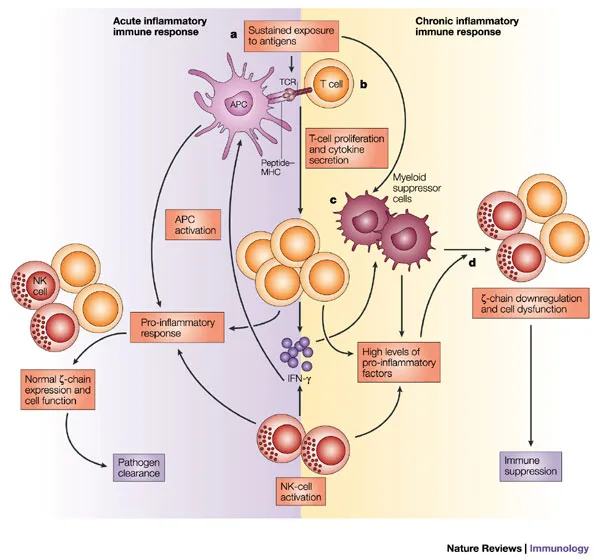
Beyond fluid management, the lymphatic system serves as the anatomical foundation of adaptive immunity. Lymph nodes — roughly 600 to 700 of them distributed throughout the body — are not passive filters. They are densely packed immune organs housing B lymphocytes, T lymphocytes, macrophages, and dendritic cells. As lymph passes through each node, antigen-presenting cells examine its contents for foreign material: bacterial proteins, viral particles, cellular debris, and other molecular signatures of infection or damage.
When a threat is detected, the node mounts a localized immune response. B cells proliferate and differentiate into antibody-secreting plasma cells. T cells activate and begin coordinating both direct cellular attack and broader immune signaling. This is why lymph nodes swell during infection — the enlargement reflects genuine immune activity, not mere congestion. The clinical term for this is lymphadenopathy, and its presence is often one of the earliest detectable signs that the body has recognized and begun responding to a pathogen.
The thymus, a lymphoid organ situated in the upper chest, plays a particularly critical role during early development. It is where immature T cells undergo a rigorous selection process, emerging as mature lymphocytes capable of distinguishing self from non-self — the fundamental discriminatory capacity that prevents autoimmune attack. Thymic activity peaks in childhood and declines with age, a process called thymic involution, which partially explains why immune responses tend to be both slower and less adaptive in older adults.
When the System Fails: Lymphedema and Chronic Inflammation
The consequences of lymphatic dysfunction are clinically significant and physiologically instructive. Lymphedema — the chronic accumulation of lymph fluid in tissues — occurs when lymphatic vessels are damaged, obstructed, or surgically removed. In the United States, secondary lymphedema following breast cancer treatment is among the most common presentations, affecting an estimated two to five million Americans. When axillary lymph nodes are removed during mastectomy or irradiated during cancer therapy, the drainage pathway for the arm is disrupted, leading to persistent, sometimes debilitating swelling.
Beyond mechanical obstruction, emerging research has linked subclinical lymphatic insufficiency to broader inflammatory conditions. Impaired lymphatic drainage means that pro-inflammatory cytokines, cellular debris, and immune complexes accumulate in tissue spaces rather than being efficiently cleared. This creates a microenvironment that sustains low-grade inflammation — a state increasingly recognized as a contributing factor in conditions ranging from obesity and metabolic syndrome to cardiovascular disease and neurodegeneration.
Perhaps most striking is the recent discovery of the glymphatic system — a lymphatic-like network in the brain first characterized in detail by researchers in the early 2010s. This system, which relies on glial cells rather than traditional lymphatic vessels, clears metabolic waste products from neural tissue during sleep. Inadequate sleep disrupts glymphatic clearance and allows neurotoxic proteins, including amyloid-beta, to accumulate — a finding that has reframed our understanding of sleep's physiological necessity and its relationship to neurodegenerative disease.
Movement, Massage, and the Physiology of Lymphatic Flow
Because the lymphatic system lacks a dedicated pump, its functional efficiency is directly tied to physical activity in ways that cardiovascular fitness metrics do not capture. Skeletal muscle contraction compresses adjacent lymphatic vessels, propelling lymph proximally through one-way valves that prevent backflow. Deep diaphragmatic breathing creates pressure gradients that draw lymph upward through the thoracic duct. Even postural shifts and gentle walking generate the mechanical stimuli that keep lymph moving.
This is the physiological basis for several clinical interventions that might otherwise seem unconventional. Manual lymphatic drainage — a specialized massage technique developed in Europe and now widely practiced in rehabilitation settings — uses light, rhythmic strokes to mechanically stimulate lymphatic vessel contractions and redirect fluid toward functional drainage pathways. For patients with lymphedema, it is not a luxury but a medically recognized component of treatment.
For the general population, the implications are more subtle but no less real. Prolonged immobility — sitting at a desk for eight or more hours, as is common in American office culture — reduces lymphatic flow in the lower extremities, contributing to the mild ankle swelling many people dismiss as unremarkable. Regular movement, even brief walking intervals throughout the day, restores the mechanical conditions the lymphatic system requires to function optimally.
Rebounding — exercise performed on a small trampoline — has attracted attention in wellness communities precisely because the vertical acceleration and deceleration it generates creates repeated gravitational shifts that many proponents claim enhance lymphatic circulation. While rigorous clinical evidence remains limited, the underlying mechanical rationale is physiologically coherent.
A System Worth Knowing
The lymphatic system will not appear on most people's radar until something goes wrong — a swollen node during a throat infection, a limb that won't stop swelling after surgery, or a research headline about the brain's waste-clearance machinery. That is a gap worth closing.
Understanding this system as a dynamic, movement-dependent, immunologically active network — rather than a passive drainage pipe — reframes how we interpret everyday symptoms, evaluate recovery strategies, and appreciate the body's extraordinary architectural complexity. Physiology does not divide neatly into headline-grabbing organs and forgettable footnotes. The lymphatic system, quiet as it is, belongs firmly in the former category.