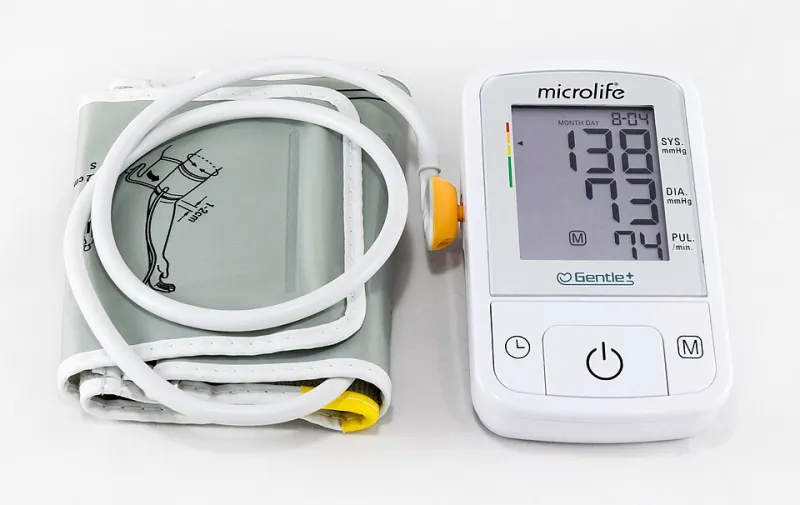
Cold Front, Higher Numbers: What Winter Actually Does to Blood Pressure

Photo: Gary, CC BY-SA 2.0, via Wikimedia Commons
Every November, primary care offices across the northern United States see the same pattern: patients whose blood pressure was acceptable in July arrive with numbers that have drifted upward by a few points, sometimes more. Nothing about their medication has changed. Their diet has shifted only slightly. What has changed is the weather, and with it a set of autonomic reflexes that predate central heating by several hundred million years.
The Reflex Behind the Reading
Cold air striking the face and hands activates cutaneous thermoreceptors, which signal the hypothalamus. Sympathetic outflow rises. Alpha-1 adrenergic receptors on arterioles in the skin and limbs constrict, shunting blood toward the core to conserve heat, and systemic vascular resistance climbs. Norepinephrine levels rise; heart rate may increase slightly; blood pressure follows.
Cold also produces a mild diuresis. As blood shifts centrally, the kidneys perceive increased volume and excrete sodium and water, leaving the blood slightly more concentrated, with higher viscosity and hematocrit. Fibrinogen and platelet aggregation rise as well. None of this is pathological in itself. It is a well-designed response to a thermal problem that happens to carry a hemodynamic cost.
The Size of the Seasonal Swing
Studies from many countries converge on a mean systolic pressure roughly 3 to 5 mmHg higher in winter than in summer, with larger differences in older adults and in people with established hypertension. A meta-analysis pooling international data found a similar magnitude and noted that the shift appears in mild climates as well as severe ones — a hint that indoor temperature, clothing, and daily behavior matter as much as the outdoor forecast.
For an individual, 4 mmHg is trivial. Across a population, a shift that size pushes a substantial number of people across the diagnostic threshold, which is one reason hypertension is diagnosed more often in December than in June. Some of the seasonal difference is also measurement artifact: cold hands, shivering, and rushing in from a parking lot all inflate a reading taken in the first two minutes.
Why February Is Hard on Arteries
Cardiovascular deaths in the United States peak in the winter months. Blood pressure is only part of the explanation. Influenza and other respiratory infections are well-documented triggers of myocardial infarction. Dietary patterns shift around the holidays, alcohol intake rises, physical activity falls, and care-seeking is sometimes delayed. The Christmas-week spike in cardiac mortality has been documented in American data for decades and reflects all of these forces at once.
Who Feels It Most
- Older adults, whose arteries are stiffer and whose baroreflexes respond more slowly.
- People already treated for hypertension, particularly if dosages were tuned during the summer.
- People with Raynaud phenomenon or diabetes, whose peripheral vasculature reacts more aggressively to cold.
- Outdoor workers and anyone living in a home that is hard to heat.
- People with chronic kidney disease, in whom sodium handling and volume regulation are already strained.
Getting a Clean Reading in a Cold Season
Measurement technique matters more in November than in June. Sit quietly for five minutes before the first reading. Keep your back supported, feet flat on the floor, and the cuff arm resting on a table at heart level. Use a validated upper-arm cuff in the correct size rather than a wrist device. Empty your bladder first; avoid caffeine, nicotine, and exercise for thirty minutes beforehand. If you have just come in from the cold, wait fifteen to twenty minutes before inflating the cuff.
Take two readings a minute apart and average them. Measure in the morning before medications and again in the evening. Record seven days rather than reacting to a single alarming number, and note the room temperature alongside the reading — a home office at 60 degrees will produce different values than a heated living room.
The Reasonable Response
A seasonal rise of a few points is not a reason to change medication on your own, and doing so can be genuinely dangerous. It is a reason to bring a week of home readings to your clinician and to ask whether a winter adjustment is warranted and how it should be reversed in spring.
Keep living spaces in the high 60s or warmer, dress in layers, and stay physically active indoors when the sidewalks are icy. Watch sodium and alcohol during the holiday stretch. Get the seasonal influenza vaccine, which has documented cardiovascular benefit in older adults. And know the warning signs that override any measurement: chest pressure, sudden unilateral weakness, difficulty speaking, or the worst headache of your life are reasons to call emergency services, not to recheck the cuff.
The seasonal climb in blood pressure is real, well characterized, and largely manageable with attention. It is a good argument for keeping a log through the winter — and a poor argument for panic.