The Gap That Matters: Reading Pulse Pressure Without Overreading It
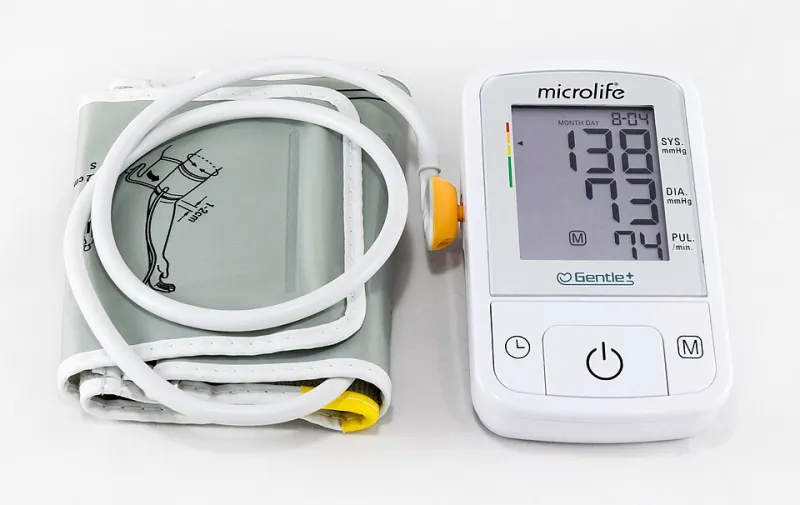
Photo: Jacek Halicki, CC BY-SA 4.0, via Wikimedia Commons
When a blood pressure reading comes back as 124/76, nearly everyone in the room gravitates toward one of the two numbers. The top figure gets blamed for stroke risk; the bottom figure gets scrutinized in middle age. The value that rarely receives comment is the difference between them: 48 millimeters of mercury. That difference is pulse pressure, and while it takes one subtraction to calculate, it takes considerably more than one reading to interpret.
The arithmetic beneath the number
Pulse pressure is systolic pressure minus diastolic pressure. Physiologically, it reflects the interplay between how much blood the left ventricle pushes into the aorta with each beat and how readily the aorta and its large branches stretch to accommodate that volume. A useful working approximation is that the gap widens when stroke volume rises or when the large arteries lose compliance, and narrows when one or both decline.
In a resting adult, a gap in the neighborhood of 40 mmHg is typical, though the distribution shifts with age. What follows are five ways that gap gets read—each offered with the same caveat: pulse pressure is a clue, not a verdict.
Reading one: a stiffening aorta writes a wider gap
The aorta is not a rigid pipe. Its wall is rich in elastin, which lets it expand during systole and recoil during diastole, smoothing the heart's pulsatile output into steadier flow downstream. Elastin, unfortunately, is not replaced efficiently. Over decades, fragmenting elastin is gradually outnumbered by stiffer collagen, and the vessel's buffering capacity falls.
Two things then happen at once. Systolic pressure climbs because the stiff aorta accepts each stroke volume less graciously. Diastolic pressure falls, partly because the recoil that normally sustains pressure between beats weakens, and partly because the reflected pressure wave returning from the periphery arrives earlier—during systole rather than after it. The result is a pattern familiar in older adults: isolated systolic hypertension, a diastolic number that looks reassuringly normal, and a gap that has quietly widened.
Reading two: a wide gap is not always about aging
Aortic stiffness is the most common explanation in an older adult, but it is not the only one. High-output states—severe anemia, hyperthyroidism, fever, arteriovenous fistulas, and aortic regurgitation—can each widen pulse pressure by increasing stroke volume or by giving blood an escape route out of the arterial tree during diastole. None of these is diagnosed from a cuff alone, and each arrives with its own constellation of findings. The point is narrower: a wide gap in a young, fit person is a reason to ask a question, not to assume a decade has been miscounted.
Reading three: a narrow gap deserves equal curiosity
Attention flows toward the wide gap, but narrowing carries its own signal. When stroke volume falls—as in hypovolemia, cardiogenic shock, or advanced heart failure—the pulse pressure narrows. Aortic stenosis dampens the ejected volume and pushes in the same direction. Rapid heart rates shorten diastole enough that diastolic pressure does not fall as far as it otherwise would, compressing the gap from the other side. In acute care, a narrow pulse pressure is treated as a hemodynamic warning sign rather than an incidental curiosity.
Reading four: some wide gaps are manufactured by the measurement
Before any physiological story is told, the number has to be trustworthy, and pulse pressure is unusually vulnerable to technique. A cuff that is too small for the arm inflates the systolic reading disproportionately. An arm hanging below heart level adds hydrostatic pressure. Talking during the measurement, a full bladder, recent caffeine, or the simple tension of being in a clinic can shift readings by several points.
Rhythm matters as well. In atrial fibrillation, stroke volume varies from beat to beat, and so does pulse pressure; a single measurement is close to meaningless, and averaging several is essential. Even in a normal rhythm, one reading in a noisy room is a weak foundation for a conclusion about arterial health.
Reading five: the gap moves with the hour, not only the decade
Pulse pressure is not a fixed personal attribute. It widens transiently during exercise, when stroke volume rises and systolic pressure climbs while diastolic pressure holds roughly steady. It shifts with anxiety, pain, fever, pregnancy, and hydration status. That is why the interesting question is not what one reading says but what a standardized series of readings shows over weeks and months.
What the gap cannot tell you
Nothing in a routine blood pressure reading measures stiffness directly. Pulse wave velocity and the augmentation index do, in research settings and increasingly in specialty clinics, but neither is derived from a cuff measurement. A wide pulse pressure is consistent with arterial stiffness; it does not prove it, quantify it, or localize it.
The practical implication is modest and unglamorous. Measure at home with a validated upper-arm cuff, seated with back supported, feet flat, arm at heart level, after five quiet minutes. Take two readings a minute apart, morning and evening, for about a week, and bring the log to a clinician. A gap that stays consistently wide at rest—roughly above 60 mmHg in an adult—or consistently narrow is worth a conversation, particularly alongside age, kidney function, and other cardiovascular risk factors.
The arithmetic of pulse pressure takes a second. The physiology behind it takes a career. Between those two facts sits the reasonable position: pay attention to the gap, and resist the urge to read a diagnosis into it.