Heat, Sweat, and Strain: The Hidden Physiology Behind Summer Athletic Performance
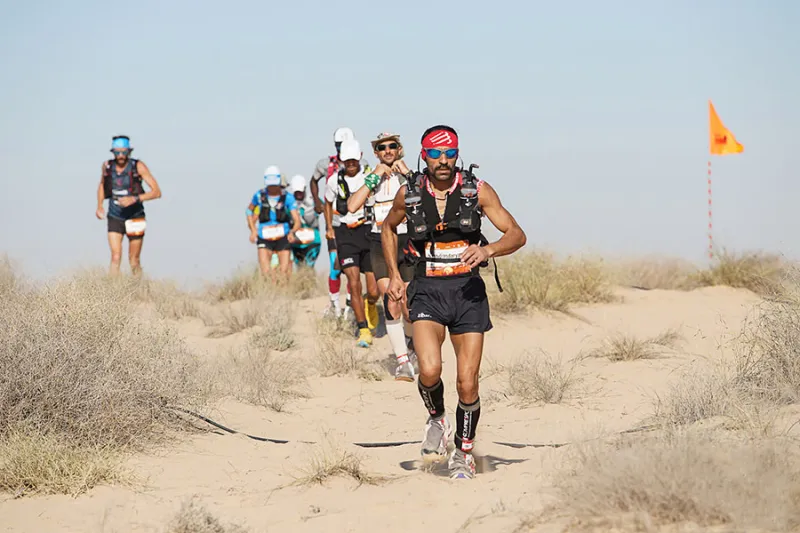
Photo: Mannytheyellow, CC BY-SA 4.0, via Wikimedia Commons
Every summer, athletes across the United States step outside for their usual run, ride, or outdoor conditioning session and encounter the same perplexing experience: the workout feels dramatically harder than it did in April, yet the distance and pace are identical. Many assume it is simply a matter of discomfort—a mental obstacle to push through. The reality, however, is rooted in measurable, well-documented physiological mechanisms that fundamentally alter how the body allocates its resources during exercise in the heat.
The Body as a Heat Engine
Human skeletal muscle is remarkably inefficient in thermodynamic terms. During vigorous exercise, roughly 75 to 80 percent of the energy produced by working muscles is released as heat rather than converted to mechanical work. Under mild ambient conditions, the body manages this internal heat load with relative ease. When environmental temperatures approach or exceed skin temperature—which regularly happens during a July afternoon in Phoenix, Houston, or Atlanta—the entire heat-dissipation equation changes.
The primary mechanism for cooling during exercise is evaporative sweat loss. As sweat evaporates from the skin surface, it carries thermal energy away from the body. This process is elegantly effective under low-humidity conditions. High relative humidity, however, dramatically reduces the evaporation rate because the surrounding air is already saturated with water vapor. In humid climates, sweat simply accumulates on the skin without providing meaningful cooling, leaving core temperature to rise unchecked.
Cardiac Drift: When Your Heart Works Overtime
One of the most significant and least-discussed consequences of exercising in the heat is a phenomenon called cardiovascular drift. Under normal conditions, the heart distributes blood according to a straightforward hierarchy: working muscles receive priority, and cardiac output is calibrated to meet metabolic demand. Heat disrupts this arrangement entirely.
As core temperature rises, the body redirects a substantial portion of circulating blood volume toward the skin, where it can release heat through radiation and conduction. This peripheral vasodilation is an appropriate thermoregulatory response, but it creates a direct competition between the muscles demanding oxygen-rich blood and the skin demanding blood for cooling purposes.
To compensate, heart rate increases—sometimes by 10 to 20 beats per minute above what the same pace would require in cooler conditions. This is why your fitness tracker may show a dramatically elevated heart rate on a humid August morning even when you are running at a pace that felt easy in March. The cardiovascular system is, in effect, serving two masters simultaneously, and the compromise costs performance.
Sweat also reduces total plasma volume. As fluid is lost through perspiration, blood becomes more viscous and stroke volume—the amount of blood ejected with each heartbeat—declines. The heart must beat faster still to maintain adequate output, compounding the strain.
Electrolyte Depletion and Neuromuscular Consequences
Sweat is not simply water. It contains meaningful concentrations of sodium, potassium, chloride, and magnesium—electrolytes that are essential for proper nerve conduction and muscle contraction. During prolonged summer training sessions, a conditioned athlete can lose between one and two liters of sweat per hour, carrying with it several hundred milligrams of sodium in each liter.
As electrolyte concentrations in the extracellular fluid decline, the electrochemical gradients that neurons and muscle fibers depend on begin to destabilize. The practical consequences include impaired coordination, increased susceptibility to cramping, and a measurable reduction in maximal force production. Research has consistently shown that a body weight loss of as little as two percent through sweat—roughly three pounds for a 150-pound individual—is sufficient to impair aerobic performance and cognitive function.
This explains why perceived exertion often diverges sharply from actual caloric expenditure during summer workouts. The body is working harder at the cardiovascular and thermoregulatory level, but muscular output may simultaneously be declining due to neuromuscular fatigue and electrolyte imbalance. An athlete may feel spent while having burned fewer calories than a cooler-weather session at the same intensity.
Why Perceived Effort and Caloric Burn Diverge
The brain plays an active role in this disconnect. The central nervous system continuously monitors core temperature through thermoreceptors located throughout the body, and it begins issuing fatigue signals well before physiological failure occurs. This protective mechanism, sometimes called the central governor model, essentially tells the body to slow down before heat stress becomes dangerous. The result is that summer workouts often feel disproportionately exhausting relative to the actual metabolic work being performed.
For athletes tracking performance metrics, this can be discouraging. Understanding that the sensation of difficulty is a legitimate physiological signal—not a sign of poor fitness—can reframe the summer training experience considerably.
Science-Backed Strategies for Hot-Weather Training
Acclimatize deliberately. The human body adapts to heat exposure over approximately 10 to 14 days of consistent training in warm conditions. These adaptations include increased plasma volume, earlier onset of sweating, and lower sweat sodium concentration. Athletes who build in a structured acclimatization period before summer competition see measurably better performance outcomes than those who do not.
Prioritize pre-hydration and sodium intake. Beginning a workout in a slightly hyperhydrated state provides a buffer against plasma volume loss. Consuming sodium in the hours before training—through food or an electrolyte beverage—helps retain that fluid in the vascular compartment where it is needed most.
Adjust pace expectations, not effort. During the hottest weeks of summer, heart rate-based training rather than pace-based training is physiologically more appropriate. Maintaining a target heart rate zone rather than a target speed allows the cardiovascular system to manage competing demands without being overloaded.
Use pre-cooling strategies. Consuming crushed ice or cold beverages before exercise, wearing ice vests during warm-up, or immersing the forearms in cold water has been shown in multiple studies to lower core temperature at the start of a session, effectively extending the time before heat-related performance decline sets in.
Respect humidity as much as temperature. A 90°F day with 30 percent humidity is physiologically far more manageable than an 85°F day with 85 percent humidity. Monitoring the heat index—which accounts for both variables—provides a more accurate picture of thermoregulatory demand than temperature alone.
The Bigger Picture
Summer training does not have to mean diminished results. It does, however, require a more sophisticated understanding of what the body is managing beneath the surface. The cardiovascular demands, the fluid and electrolyte dynamics, and the brain's protective fatigue responses are all operating simultaneously during every hot-weather session. Athletes who treat these mechanisms as variables to be managed—rather than obstacles to be ignored—will find that summer can be a productive training season rather than simply a difficult one.