No Cleanse Required: The Unglamorous, Unceasing Work of Your Kidneys
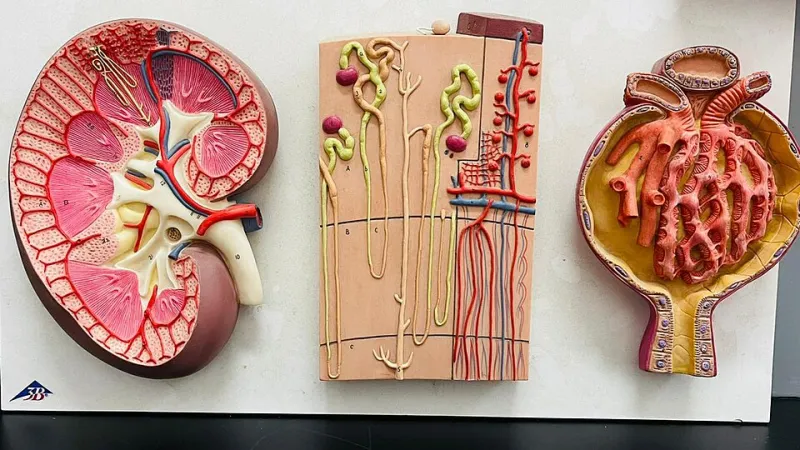
Photo: Rayhana Alhour, CC0, via Wikimedia Commons
Walk down the supplement aisle of any American pharmacy and you will find boxes promising to flush, cleanse, or reset your kidneys in ten to fourteen days. The packaging usually features dandelion root, cranberry extract, or a green powder with a name like a river. The premise underneath all of it is consistent: the kidneys are passive filters that accumulate residue, and the right product can rinse the residue away.
That premise is not a simplified version of renal physiology. It is a different one, and it happens to be wrong in ways that matter.
A million filters, none of which need prompting
Each human kidney contains roughly a million nephrons, and each nephron begins with a glomerulus—a tuft of capillaries wound into a ball and wrapped in a filtration barrier three layers thick. The first layer is a fenestrated endothelium, perforated with pores. The second is a glomerular basement membrane rich in negatively charged glycoproteins. The third is a set of podocytes whose interlocking foot processes form slit diaphragms.
Together these layers discriminate by size and by charge. Small molecules and water pass; albumin and larger proteins are held back. The pressure driving filtration comes from the heart, regulated locally by the tone of the afferent and efferent arterioles. The resulting glomerular filtration rate in a healthy adult is about 125 milliliters per minute, which works out to roughly 180 liters a day.
That single number should retire the sludge metaphor. The kidneys process the equivalent of the entire plasma volume dozens of times over the course of a day, continuously, without instruction from a capsule.
The real work is retrieval, not flushing
About 99 percent of the filtered water and sodium is reabsorbed before it ever reaches the bladder. The proximal tubule reclaims the bulk of it, along with glucose, amino acids, and bicarbonate. The loop of Henle builds a concentration gradient in the medulla through countercurrent multiplication, allowing the collecting duct to fine-tune how much water is returned to the blood. Antidiuretic hormone inserts aquaporin-2 channels in that duct when the body needs to conserve water; aldosterone adjusts sodium reclamation and potassium secretion further upstream.
The tubules are not passive either. They actively secrete potassium, hydrogen ions, and organic anions into the forming urine—which is how the kidney regulates blood pH and disposes of drug metabolites. Beyond filtration, the organ produces erythropoietin to stimulate red cell production, activates vitamin D, and contributes to gluconeogenesis during fasting.
A colander does none of this. The kidney is closer to an editor with a red pen, deleting nearly everything and reinstating most of it after review.
What the word toxin is doing in that sentence
The excretory workload is real and nameable: urea from protein metabolism, creatinine from muscle turnover, uric acid from purine breakdown, conjugated bilirubin, hormone metabolites, drug byproducts, hydrogen ions, and potassium. The liver performs the chemical transformations; the kidney handles water-soluble export. That division of labor has been characterized in detail for over a century.
Marketing language rarely engages with any of it. A product promising to eliminate toxins almost never specifies which compounds are being removed, by what mechanism, or how removal was measured. Under the regulatory framework that has governed dietary supplements in the United States since 1994, firms are not required to demonstrate efficacy before sale. There is no body of controlled evidence showing that commercial cleanse products improve glomerular filtration or clearance in people with healthy kidneys.
Where the cleanse can bite back
Herbal and botanical products appear repeatedly in case series of drug-induced kidney injury, sometimes through direct toxicity, sometimes through contamination or mislabeling. Aristolochic acid, found in certain plants used historically in weight-loss and herbal preparations, remains one of the clearest examples of nephrotoxicity from a natural product.
Other risks are more mundane. Very high-dose vitamin C can raise oxalate excretion and, in susceptible people, contribute to oxalate nephropathy. Aggressive water intake in a short window can dilute plasma sodium. Sodium phosphate preparations used for bowel cleansing have been linked to acute phosphate nephropathy, particularly in older adults and those with reduced kidney function. Potassium-heavy green powders are a genuine hazard for anyone with chronic kidney disease, and combining diuretic-style products with dehydration and nonsteroidal anti-inflammatory drugs is a well-worn path to acute injury.
The program that does have evidence behind it
Kidney protection is unglamorous because it is mostly the management of ordinary things. Blood pressure control is the single most consequential lever. Blood glucose control matters in diabetes, which remains the leading cause of kidney failure in the United States. Smoking cessation, moderation of dietary sodium, and restraint in the use of NSAIDs all have support. Fluid intake adequate to thirst is sufficient; there is no good evidence that drinking beyond thirst improves filtration in healthy people.
Protein intake around 0.8 grams per kilogram of body weight remains a reasonable general target; high-protein diets have not been shown to damage healthy kidneys, but they offer no renal advantage either. Medication review matters, particularly for lithium, calcineurin inhibitors, and repeated contrast exposure. For adults with diabetes, hypertension, or a family history of kidney disease, annual screening with estimated glomerular filtration rate and a urine albumin-to-creatinine ratio is the sensible step.
Silence is the symptom
Roughly one in seven American adults has chronic kidney disease, and most do not know it. The condition is quiet until it is advanced, which is precisely why screening rather than symptom-chasing is the strategy that works.
None of this makes a compelling label. It does make a fair description of what the organs do all night while you sleep, without a kit, a powder, or a fourteen-day plan. The kidneys are already running the cleanse. The most useful thing most people can do is stay out of the way.